8+1 useful tips to help your interpreter – Hajna Keszthelyi – Hungarian Interpreter
8+1 useful tips to help your interpreter
Sometimes people think interpreters possess a special kind of superpower that makes them able to translate complicated speeches seamlessly practically in the blink of an eye. We like to think this is true; however, we are not superhumans, thus there are some factors that can help us do our magic better and some that make it harder. Whether you are an event planner, educator, a speaker, or someone needing interpretation services at a meeting or on-site visit, here are some tips that will make sure the intended message comes across loud and clear.
1. Give as much information as possible
While most interpreters are experts in some specialised fields, you can hardly expect us to be as well versed in all of them as the speakers we are translating for. We have some smart tactics to prepare for a wide range of topics: we look through your website, read some articles and inform ourselves about your company, but we are grateful if you assist us. Your brief doesn’t have to be brief: Beyond specifying your industry, give an overview of the presentation and the meeting topic. Share any materials you’ll be using—business plans, slides, promotional content—and feel free to suggest articles that use your terminology (even better if you can provide a glossary). Sending us recordings of earlier presentations will help us to get used to the style and accent of the speaker.
2. Share your notes
A lot of speakers prepare notes to help keep their talk structured, stay on track and to remember all important information and details. Even if these are only bullet points, or a few key words, this is invaluable for an interpreter. This is especially so if your talk includes numbers, dates, lists, quotes, names or other proper nouns.
3. Share your slides
Getting your PPT presentation upfront is an immense help for us. We will get the hang of the topic and the structure of your talk and might find some terms that we want to look up. We can also follow it on a tablet – and avoid turning our back to the audience when we need to translate something from your slides.
4. Share your manuscript
If you have written your speech beforehand, sharing the manuscript with your interpreter is a must. Ideally this would happen a few days or at least few hours prior to your event, so we can translate and render it in a way that is as seamless and eloquent as the original. However, if you are only ready with it the last minute, print a second copy, so we can provide sight translation. Clients are mostly unaware of the added difficulty of interpreting a prewritten speech as opposed to an improvised talk. This is especially true when your speech is interpreted simultaneously. If we do not have a transcribed copy we will still manage, but easily miss some parts – while growing a few strands of grey hair.
Even if you are not the speaker but the event planner, remember to ask for these materials in time as speakers and interpreters usually do not have direct contact before events. Do not be the missing link!
5. Talk to your interpreter – before you start
Take some time to talk to your interpreter before your speech. If we have not met before you will have a chance to introduce ourselves, you can tell us the goal of your presentation, the effect you want to achieve and share any information that can help convey your message better.
Having a personal connection helps with jitters. While the “invisibility” of an interpreter is part of her professionalism, this time you are not facing your audience alone; we have your back.
6. Think of your interpreter
Even some of the most experienced speakers are not used to being translated and tend to forget to pause for interpretation. It takes significant effort during interpreting to remember everything that was said. While stopping mid-sentence is not a good idea as the structure of languages differ from one another, it makes sense to keep sections reasonably short.
If the interpreter takes notes, during consecutive interpreting she can adjust to longer stretches, but keep in mind that these are not word for word transcripts. If you speak for a few minutes at a time, the translation will be more of a re-rendering of your speech. There are scenarios where this works better but it is good to be aware of the fact, make a conscious choice and discuss this before hiring an interpreter.
Speak clearly and pay attention to your pace. If you speak too slowly it can make it difficult to follow your train of thought at consecutive interpreting, while speaking too fast can cause information to get lost in simultaneous interpretation.
7. Technical background
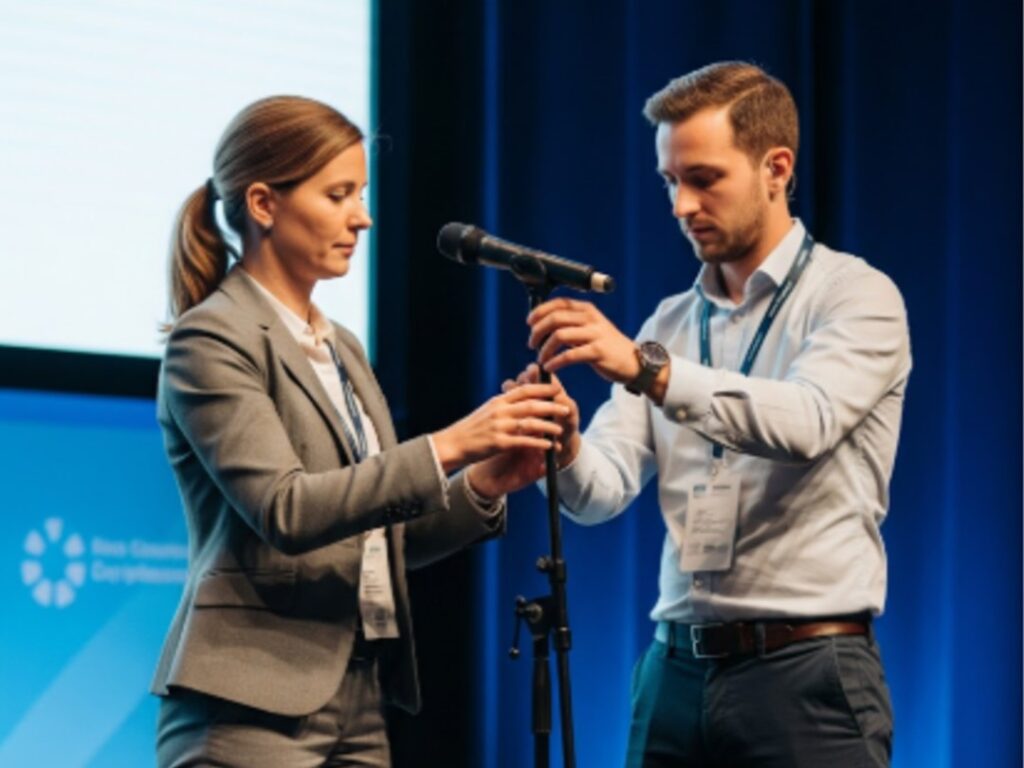
Needless to say, the organizer of the event needs to provide the technical facilities of interpretation. Besides providing a microphone in larger halls, you have to make sure that your interpreter clearly hears what is being said. This might call for a monitor speaker (a loudspeaker specifically directed towards the interpreter) and you need to provide a booth for simultaneous interpretation. Do a sound check from the place where the interpreter will sit or stand. (I have been in some very inconvenient situations where I could hardly hear the speaker due to the acoustics of the room – despite being relatively close to them.)
8. Give us a break
The cognitive load involved in interpreting requires frequent breaks. Imagine it as a mental sprint: it demands exceptional performance but it cannot be sustained without rest. In simultaneous interpreting, the standard for assignments exceeding one hour is that two interpreters work in 20–30 minute shifts. This is the maximum duration we can maintain peak concentration for. The breaks between turns serve recovery, and the partners may also assist each other. This is not luxury: during these pauses, we allow our “mental pulse” to return to normal.
In consecutive interpreting, the strain is somewhat different. There is slightly more time to formulate thoughts, but the memory load is higher. In this mode, the interpreter can handle longer presentations or conversations, but after one or two hours, a substantial break is necessary, and the amount of rest needed may exceed what the other participants of a conference typically require. If interpretation is needed for an all-day stage programme, it is wise to have more than one professional. Naturally, this depends on the context. A factory tour, for example — where the group walks a few minutes between areas, has lunch, and then moves on to a closed meeting — can easily be managed by a single interpreter, even if the programme lasts the whole day.
+1. We appreciate feedback
If you are satisfied with our performance, it will make us happy to hear it, but if you feel there is room for improvement, we will appreciate your honest feedback and suggestions. You might not understand the language we speak but you will feel if we take too much time, were uncertain or distracting in any other way. A polite, constructive critique can be helpful to give us some pointers to improve our performance or adjust to your personal preferences.
Leave a recommendation! Most interpreters rely on their online presence, so a few stars and a kind word on Google or LinkedIn can make a huge difference. Your feedback helps others find reliable interpreting services — and it means the world to us.
While it is important to talk to your audience during your speech – and not directly to your interpreter – do not forget us. We assist you professionally in conveying your message to your audience, and we are grateful when you help our preparation and on-site work in a thoughtful way.